 d
d
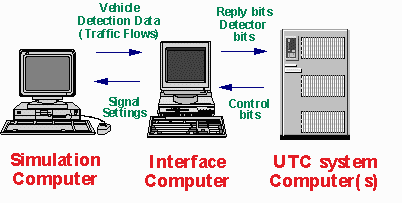
Figure 1: A typical interface between a UTC system and a simulation package
The objective of this research project is to define procedures for including flow variability in the micro-simulation evaluation of traffic schemes that use responsive traffic control measures.
If the same journeys were made every day at the same time under the same conditions, the control of traffic would be relatively simple. A fixed signal plan which minimised costs (eg total delay) could be used. However, traffic flows vary unpredictably. Responsive urban traffic control systems have therefore been developed which measure the flows and respond by adapting signal plans in an attempt to maintain minimised costs. Measuring the effectiveness of these systems is not straightforward. When the flows follow the average daily flow profile precisely, the responsive systems will tend to duplicate the performance of fixed time signal systems. They achieve their extra benefits from adapting to variation in the flows away from the expected daily flow profile; because of changes within; or because of long term changes to the daily profile (Bell and Bretherton (1986)). A common way of assessing these new systems is to use computer micro-simulation models (Figure 1.) (see e.g. Barcelo et.al. (1989), Rathi and Santiago (1990), Mauro (1991), Sutomo (1992), Shepherd (1993), May and Montgomery (1993), Priyanto (1994), Clark et.al. (1994), Crosta (1994), Anderson et.al. (1994), Fox et.al. (1995a), Fox et.al. (1995b), Fox et.al. (1995c), Liu et.al.(1995), Paksarsawan et.al. (1995), Pretty et.al (1995)).
One of the main advantages that they have over real life on-street trials is that the traffic flows can be controlled. This ensures that any measured benefits are sure to be due to the system under test and are not due to any external influence that might affect flows during a field trial. The amount of flow variability is a key issue in the evaluation. If there is too little variability the performance of the responsive system would be underestimated, if there is too much variability the performance of the fixed signal plan used for comparison will be poor and the performance of the responsive system would therefore be over estimated. It is clear therefore, that to assess a responsive system, simulation runs should be carried out that show realistic variations in the traffic flows. However, it is very difficult to find general analysis of these variations. The sources of variability need to be determined and quantified. Fortunately, much of the data required to assess this variability is already available from both field trials and data collected by responsive systems themselves.
The project will therefore
The results from this research will be essential for anyone using or developing a micro-simulation model for the design, development and assessment of responsive traffic control systems, a field in which the UK is a major player.
It is becoming normal for the traffic in urban areas to be controlled by systems which adapt according to traffic flows. They are usually implemented via signalised control, which through on-street implementation and evaluation has been shown to be a cost-effective method of reducing congestion. New schemes are now being developed which take advantage of improvements in detection, communications and computing. These include improved traffic signal control, automatic route guidance and variable message signs. Before they can be implemented, these systems need to be evaluated. A common way of doing this is by developing a micro-simulation of the proposed trial site. It is not always common however to include flow variability in the assessment, but where this is done (MVA Consultancy (1989)) it is usually of an ad hoc nature. Research has been carried out into the variability of travel times and its causes (McLeod and Hounsell (1993), May et.al. (1989)). The approaches used will also be useful in this study.
Recent research at ITS (Clark et.al. (1994)) using a micro-simulation model linked to responsive traffic control systems has revealed a lack of standards for the calibration and assessment of the micro-simulation runs. Without care this can easily lead to erroneous conclusions, resulting in ineffective systems being implemented. This research project will help ensure that this does not happen. One of the recommendations made in the final external assessment of this project was that "further work should be commissioned" to study these problems.
The UK Department of Transport (1995) has recently identified the requirements and research needs for the development of Urban Traffic Management and Control (UTMC) systems. One priority area identified was the development of a tool to assess traffic control strategies for use in UTMC, which includes the identification of all input needs. This research project will clearly provide an essential input to the development of such a tool.
The immediate beneficiaries of this research will be developers of responsive traffic control systems and micro-simulation models. These include both industrial and academic researchers. If the guidelines produced are followed then greater confidence will be attached to micro-simulation evaluation. This should result in increased confidence in the benefits to be obtained by the implementation of responsive traffic control systems, increasing their marketability. Increased use of advanced UTC systems will result in better management of traffic with consequent benefits to road users and the general public. The cost of traffic congestion is substantial, and inefficient traffic management can be very expensive. The research will also benefit traffic engineers and economists carrying out assessments. The data collected on flow variability will be particularly useful for calibrating traffic assignment models that account for day-to-day variability.
Papers to be produced by this research have been clearly identified in the work programme. In addition to their publication in refereed and professional journals, it is intended to make the results of this research available on the Internet. This will include copies of the papers on the World Wide Web pages of the University of Leeds. A presentation of the results will also be made at the TRB conference in Washington during the year. Contact with previous industrial partners will help to ensure that the results are used in the development of commercial products.
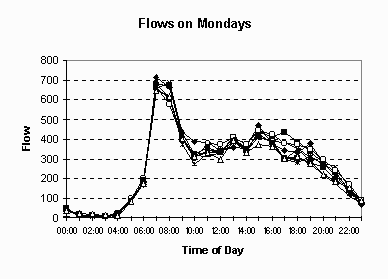
It is well known that traffic flows vary according to the time of day, the day of the week and the season. Therefore when trying to determine an optimal set of fixed time signal plans a traffic engineer will use various sets of flows for these different time periods. A typical set of actual hourly traffic flows for one day of the week are shown in Figure 2.
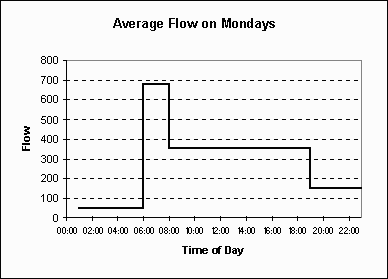
The traffic engineer would derive a set of signal plans based on the averageflows for the specific time periods as shown in Figure 3.
A responsive UTC system measures the actual flows and recalculates the optimum signal plans according to those measured flows. The benefits thatwill be obtained from using a responsive system over a fixed time system willcome from its reaction to flows away from the flow profile of Figure 3. Ifone uses computer simulations to assess the benefits of using a responsivesystem, runs should be carried out using a realistic variation in a set ofdaily flow profiles. Such information is not currently readily available, therefore the purpose of this research project is to collect suitable setsof flow data, categorize its variability, use it in some trialmicro-simulations and produce guidelines for its use in the evaluation ofresponsive traffic control schemes.
Sources of traffic flow data for analysis will be sought. Although it is quite common to collect flow data for input into traffic models and during field trials, much of this data is usually only collected for a short time period. Ideally the data for this analysis will have been collected continuously over time periods in excess of a year. Responsive urban traffic control systems need to react to changes in flows so they automatically collect data, usually via inductive loops embedded in the road. Unfortunately the data collected by this method is not precisely flow data. If a section of road contains more than one lane then ideally the UTC system would measure the flows in both lanes. However cost constraints can mean that it is only possible to put down a single loop straddling all the lanes. Even if a loop is put in each lane there can be problems when vehicles do not keep in lanes. Further problems occur in congested conditions when queues of slow moving vehicles extend back over the loops, resulting in a low number of vehicles crossing the loops.
The Instrumented City in Leicester has been collecting such data from the SCOOT UTC system since November 1990, along with ancillary data which will be very useful in determining the causes of variation. This includes information on accidents, road works and the weather. The SCOOT UTC systemhas also been providing data for ASTRID databases (Hounsell et.al. (1990)) in both London and Southampton. All the SCOOT data is available in five minute intervals.
Previous work (Carden et.al. (1989), Baker and Wood (1991) and Bell et.al. (1994)) has demonstrated that SCOOT's estimates of flow are accuratein most circumstances as long as they are multiplied by link specific scaling factors. In this project, on-street surveys will be carried out to measurethese factors where necessary. Also, work will be carried out to assess the accuracy of SCOOT's flow estimates when there is queuing over the detection loop and when traffic flows are very low, as recent work carried out by UNTRG (Bell et.al. (1996)), and other results that have appeared in the literature, have indicated that SCOOT's parameter estimates deteriorate in these circumstances. The use of the M19 and M29 messages has been found to be a much more accurateindicator of the flow level. These messages are being captured on a regula basis now and a comprehensive assessment will need to be carried out for this research project. Three months of research assistant's time will benecessary for this.
Local authorities and the Department of Transport also collect traffic flow data that could prove useful for this study. A search will be made for anyuseful data sets.
Obviously, traffic flows within a signalised area depend heavily on thesignal settings, therefore most effort will be directed at links on the edgesof the networks, before they come under the influence of the signals.
All the data collected will be put into a common format and added to astructured time stamped database of traffic flows. Information on road type,weather conditions, incidents and road works on the link and adjacent linkswill also be collected.
Output:
The variation in traffic flows will be investigated. As traffic flows varyaccording to the time of day, the day of the week and the season, for eachlink investigated the flows will therefore be grouped according to thesevariables. Mean daily flow profiles for each group will be determined andstandard techniques for the analysis of variance used to examine thedistribution of short and long period fluctuations away from these profiles.
Work package 3: Categorization of variabilityCorrelations between the flow variations and a number of indicators, such asweather conditions, the presence of road works or incidents, etc., will besought. Flows on a link can vary for a number of reasons. These can bebehavioural (eg route choice or driver behaviour), changes in demand (egtaking holidays, changing delivery dates), due to incidents (eg accidents orillegal parking) or due to external influences (eg rain affecting vehiclespeeds and hence flows). This work package will use standard statisticalmethods to determine the effect on flows of each of these causes wheresuitable data is available.
Software will be produced to generate a spread of realistic daily flowprofiles for a link.
Output:
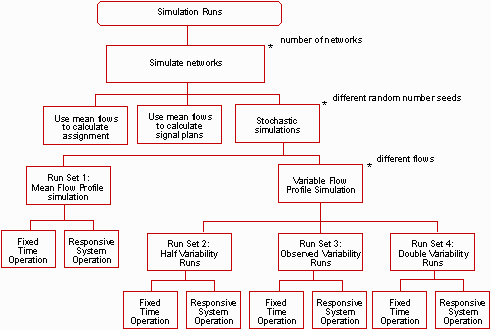
This work package will determine what happens when this variability isincorporated into a micro-simulation and used to evaluate a responsive system.It will determine the importance of using the correct level of variability. A series of simulation runs will be carried out on a variety of networksunder the control of both fixed time and responsive UTC systems. The hierarchical structure diagram of the simulation plan is shown in Figure 4.
A number of networks will be used for this study. Many of these networks are available from previous studies, although this means that more than onemodel will have to be used for the simulations. A mean flow profile will beused to calculate a set of fixed time signal plans and traffic assignment for each network. Then four sets of runs (See Figure 4) will be carried out foreach network, each set using a different random number seed. It should benoted that the randomness introduced by using different random number seedsis not the prime subject of this research project. Different random number seeds generate different streams of random numbers to be used within the simulation to determine turning movements and vehicle generation. This procedure is used to investigate inherent variability within the system while keeping the input flows the same from run to run.
This project is looking at the effects of using different daily flowprofiles, so as well as using different random number seeds, different flow profiles will also be used. Statistical analysis will ensure that sufficient runs are carried out to distinguish between inherent variability and theeffect of varying the flows. Each set of runs will be performed under bothfixed time and responsive system operation. The first set will just use the mean flow profile. The remaining three sets will use sets of flows withvariability less than, equal to and greater than that determined by Work package 2.
When all the simulation runs have been carried out, the results will beanalysed.
The following areas will be investigated:
Output:
This work package will use the results obtained to produce guidelines for theevaluation of responsive systems by micro-simulation. This will answer the following questions:
Output:
The project has the following Aims and Goals:
Aims:The project can be judged a success if all the goals are achieved and thepapers are accepted for publication in refereed and professional journals.